

1 题目
给你链表的头结点 head ,请将其按 升序 排列并返回 排序后的链表 。
示例 1:
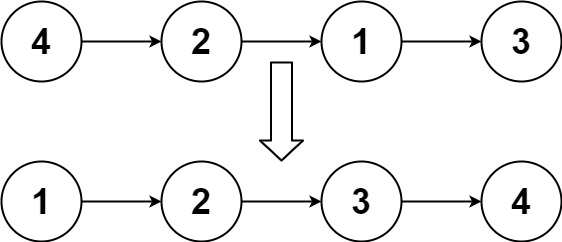
输入: head = [4,2,1,3] 输出:[1,2,3,4]
示例 2:

输入: head = [-1,5,3,4,0] 输出:[-1,0,3,4,5]
示例 3:
输入: head = [] 输出:[]
2 题解
2.1 辅助数组
2.1.1 核心思想
一句话核心:把链表问题,转化为数组问题求解。
链表的软肋是不能随机访问、不好排序;数组的强项是支持随机访问、排序成熟高效。
所以我们采用迂回策略:
摘节点 → 数组排序 → 重新串成****链表
不改动节点数据、不新建节点,只改变「指针的连接顺序」。
2.1.2 代码
/**
 * Definition for singly-linked list.
 * struct ListNode {
 *     int val;
 *     ListNode *next;
 *     ListNode() : val(0), next(nullptr) {}
 *     ListNode(int x) : val(x), next(nullptr) {}
 *     ListNode(int x, ListNode *next) : val(x), next(next) {}
 * };
 */
class Solution {
public:
    ListNode* sortList(ListNode* head) {
        vector<pair<int, ListNode*>> pil;
        ListNode* cur = head;
        while(cur) {
            pil.push_back({cur->val, cur});
            cur = cur->next;
        }
        sort(pil.begin(), pil.end(), [](pair<int, ListNode*>& p1, pair<int, ListNode*>p2) {
            return p1.first < p2.first;
        });
        ListNode dummy = ListNode(0);
        ListNode* tail = &dummy;
        for(auto node: pil) {
            tail->next = node.second;
            tail = tail->next;
        }
        tail->next = nullptr;
        return dummy.next;
    }
};
2.1.3 复杂度
时间复杂度:,
sort的时间;遍历链表两次 空间复杂度:,vector 存了全部节点指针
2.2 自顶向下归并排序(递归版)
2.2.1 核心思想
- 分割:快慢指针找到链表中点,切断链表拆成左右两部分
- 左递归:递归对左子链表执行排序
- 右递归:递归对右子链表执行排序
- 合并:将排序完成的左右两条有序链表合并为一条,向上返回
递归终止条件是基础保护:
if(!head || !head->next) return head;,不属于这 4 行核心业务逻辑。
2.2.2 代码
/**
 * Definition for singly-linked list.
 * struct ListNode {
 *     int val;
 *     ListNode *next;
 *     ListNode() : val(0), next(nullptr) {}
 *     ListNode(int x) : val(x), next(nullptr) {}
 *     ListNode(int x, ListNode *next) : val(x), next(next) {}
 * };
 */
class Solution {
public:
    ListNode* sortList(ListNode* head) {
        if(!head || !head->next) {
            return head;
        }
        ListNode* slow = head;
        ListNode* fast = head->next;
        while(fast && fast->next) {
            slow = slow->next;
            fast = fast->next->next;
        }
        ListNode* mid = slow->next;
        slow->next = nullptr;
        ListNode* left = sortList(head);
        ListNode* right = sortList(mid);
        return merge(left, right);
    }
    ListNode* merge(ListNode* l1, ListNode* l2) {
        ListNode dummy(0);
        ListNode* cur = &dummy;
        while(l1 && l2) {
            if(l1->val < l2->val) {
                cur->next = l1;
                l1 = l1->next;
            } else {
                cur->next = l2;
                l2 = l2->next;
            }
            cur = cur->next;
        }
        cur->next = l1 ? l1 : l2;
        return dummy.next;
    }
};
2.2.3 复杂度
时间复杂度: 空间复杂度:(递归调用栈)
2.3 自底向上归并排序(迭代版)
2.3.1 核心思想
- 测长度:先遍历一遍统计链表总长度,决定需要合并几轮
- 外层轮数:合并段长
seg从 1 开始,每轮翻倍(1、2、4、8…),直到seg ≥ length覆盖整条链表 - 内层合并:把链表按
seg长度切成一段段,相邻两段merge成一个更大的有序段,每轮把整条链表重连一遍 - 返回结果:所有轮次结束,整条链表完全有序,返回头节点
辅助函数:
cut(head, k)截断前 k 个节点并返回下一段起点;merge(l1, l2)合并两条有序链表。这两个不属于核心思想,但写代码必须要有。
2.3.2 代码
/**
 * Definition for singly-linked list.
 * struct ListNode {
 *     int val;
 *     ListNode *next;
 *     ListNode() : val(0), next(nullptr) {}
 *     ListNode(int x) : val(x), next(nullptr) {}
 *     ListNode(int x, ListNode *next) : val(x), next(next) {}
 * };
 */
class Solution {
public:
    ListNode* sortList(ListNode* head) {
        if(!head || !head->next) {
            return head;
        }
        int length = 0;
        ListNode* cur = head;
        while(cur) {
            length++;
            cur = cur->next;
        }
        ListNode dummy(0);
        dummy.next = head;
        for(int seg = 1; seg < length; seg <<= 1) {
            ListNode* tail = &dummy;
            ListNode* cur = dummy.next;
            while(cur) {
                ListNode* left = cur;
                ListNode* right = cut(cur, seg);
                cur = cut(right, seg);
                tail->next = merge(left, right);
                while(tail->next) {
                    tail = tail->next;
                }
            }
        }
        return dummy.next;
    }

    ListNode* cut(ListNode* head, int k) {
        while(--k && head) {
            head = head->next;
        }
        if (!head) return nullptr;
        ListNode* next_start = head->next;
        head->next = nullptr;
        return next_start;
    }

    ListNode* merge(ListNode* l1, ListNode* l2) {
        ListNode dummy(0);
        ListNode* cur = &dummy;
        while(l1 && l2) {
            if(l1->val < l2->val) {
                cur->next = l1;
                l1 = l1->next;
            } else {
                cur->next = l2;
                l2 = l2->next;
            }
            cur = cur->next;
        }
        cur->next = l1 ? l1 : l2;
        return dummy.next;
    }
};
2.3.3 复杂度
时间复杂度: 空间复杂度:
2.4 三种算法对比
| 方案 | 核心思路 | 时间复杂度 | 空间复杂度 | 代码难度 | 核心特点 |
|---|---|---|---|---|---|
| 辅助数组法 | 遍历链表收集节点指针,数组排序后重新串联节点,空间换简单 | O(nlogn) | O(n) | ⭐ | 笔试速通首选;需要处理尾节点置空,否则链表成环,不满足进阶 O (1) 空间 |
| 自顶向下归并(递归) | 分治,快慢指针二分拆链表,递归排序左右子链表,最后合并有序链表;先拆后合 | O(nlogn) | O(logn)(递归栈) | ⭐⭐ | 面试最常考,代码简洁好写;递归栈占用空间,无法做到严格常数空间 |
| 自底向上归并(迭代) | 迭代,从长度为 1 的有序小段开始两两合并,段长不断翻倍直至整条链表有序;从小段到大段合并 | O(nlogn) | O(1) | ⭐⭐⭐ | 本题最优解,无递归,满足进阶 O (1) 空间;需要实现 cut 截断函数,逻辑稍复杂 |